

In today’s fast-paced technology landscape, measuring software delivery performance is crucial to achieve high stakes. Companies leveraging precise performance metrics gain the capability to optimize their processes, enhance agility, and drive innovation. This is where DORA Metrics come into play, offering actionable insights for engineering teams aiming for excellence.
Velocity & Stability
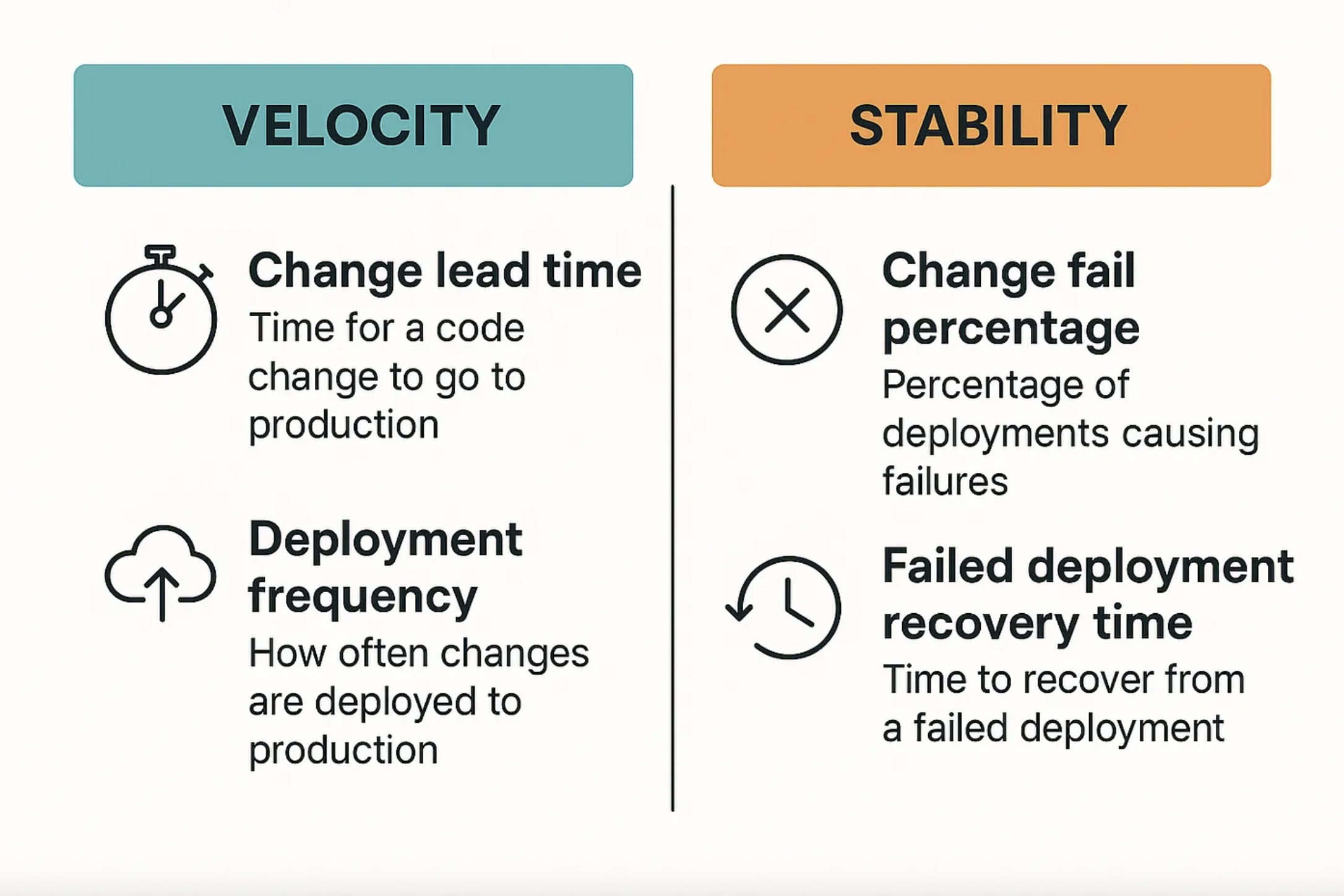
Typically, the faster the engineering teams deliver is the lower the stability of the code in production. Velocity metrics focus on the speed and frequency of software deployments, while stability metrics emphasize the quality and reliability of those deployments. By leveraging these grouped insights, engineering teams can achieve a balanced approach, ensuring both rapid innovation and robust operational stability.
- Deployment Frequency (DF)
This metric indicates how often an organization successfully releases software to production or end-users.
Why does DF matter?
– Frequent deployments correlate strongly with increased agility and responsiveness.
– It signals healthy DevOps practices, such as continuous integration and continuous deployment (CI/CD). - Lead Time for Changes (LTC)
This measures the time it takes for code to move from commit to deployment in production.
Why does LTC matter?
– Shorter lead times imply efficiency and a streamlined development cycle.
– Long lead times can indicate bottlenecks or inefficiencies, reducing competitive responsiveness. - Change Failure Rate (CFR)
Change failure rate reflects the percentage of deployments causing incidents, requiring immediate attention or rollback.
Why does CFR matter?
– Low failure rates demonstrate reliability in the development and deployment processes.
– High failure rates might suggest insufficient testing or risky deployment practices. - Mean Time to Recovery (MTR)
This metric tracks the average time required to restore a service after a failure or incident.
Why does MTR matter?
– Quick recovery minimizes downtime, significantly enhancing customer satisfaction.
– Longer recovery times negatively impact user experience and overall business performance.
The goal is to achieve the highest Velocity with the lowest acceptable Stability.
Conclusion
Effectively leveraging DORA metrics positions organizations to significantly enhance their software delivery capabilities, achieving both velocity and stability. For companies aiming to swiftly adopt these insights and unlock their full potential, DBServices Portugal provides the specialized Automation and DevOps Assessment service. This comprehensive service evaluates your current practices, identifies critical bottlenecks, and proposes targeted solutions to accelerate deployments, increase reliability, and optimize overall software quality. By partnering with DBServices Portugal, organizations ensure they remain at the forefront of DevOps excellence and continuous innovation.