

Held from April 20 to 24, Hannover Messe 2026 recently concluded its activities, once again reinforcing its position as the world’s leading stage for industrial transformation. Under the theme “Think Tech Forward,” this year’s edition made one thing clear: the testing phase of Industry 4.0 is over — technologies are now being implemented at scale to solve real efficiency and climate challenges.
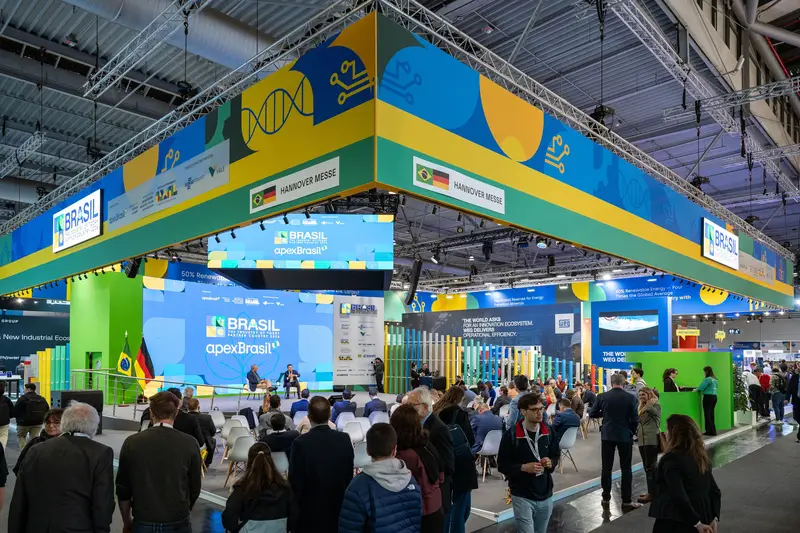
DBServices was present with its own booth in a setting where Brazil took on global prominence as the Official Partner Country of Hannover Messe 2026, the world’s largest industrial innovation trade fair.
Official Partner Country
The Brazil Pavilion, coordinated by ApexBrasil, covered 2,660 m² and brought together companies, institutions, and government representatives to strengthen the country’s global image and generate new international business opportunities.
The program included panel discussions, pitch sessions, networking opportunities, and the official opening ceremony with authorities from both countries, reinforcing Brazil’s positioning in key areas such as Industry 4.0, sustainability, energy transition, biofuels, green hydrogen, and artificial intelligence, before an audience of more than 130,000 qualified visitors and around 4,000 exhibitors from approximately 60 countries.
Below is a compilation of the key insights, news, and technology trends that dominated the event.
1. The Consolidation of Industrial and Generative AI
Artificial Intelligence has moved beyond being a futuristic concept and has become the central engine of the factory floor.
Generative AI in Practice
The event demonstrated how AI is being used to automate robot programming and optimize workflows in real time, allowing engineers to interact with machines through natural language commands.
Advanced Predictive Maintenance
AI-powered tools were presented not only to predict failures, but also to prescribe exact solutions, integrating directly with supply chains to automatically request replacement parts when needed.
2. Green Hydrogen and Industrial Decarbonization
Energy transition and sustainability were dominant pillars of the event, driven by the ambitious climate targets set for 2030.
Hydrogen Ecosystems
The exhibition highlighted the shift from pilot hydrogen projects to industrial-scale infrastructure, essential for decarbonizing heavy industries such as steelmaking and chemicals.
AI-Based Energy Management
Companies presented AI-driven multi-use energy models capable of reducing industrial electricity costs by up to 30%, optimizing battery storage and managing peak load demand more efficiently.
3. Manufacturing-X and the End of Data Silos
Interoperability was treated as both a geopolitical and technological turning point.
Data Sovereignty
The advancement of the Manufacturing-X initiative showed how industries are building secure and standardized data spaces. This enables suppliers and manufacturers to collaborate on unified cloud platforms while ensuring full traceability for the circular economy without compromising industrial secrets.
Competition for Standards
It became evident that there is a global race for technological standards, with European nations and their partners seeking open alternatives to compete with strategies such as China Standards 2035.
4. Humanoid Robotics and Subscription-Based Models
The way companies acquire and operate technology is changing dramatically.
Collaborative and Humanoid Robots
Beyond traditional cobots (collaborative robots), the presence of humanoid robots with a broad range of industrial applications attracted significant attention, demonstrating advanced capabilities to operate in environments originally designed for humans.
Hardware as a Service (HaaS)
Studies presented during the event revealed strong adoption of subscription-based industrial models. With AI and software driving automation, plug-and-play systems are allowing small and medium-sized companies to adopt advanced robotics without high upfront capital investments.
Brazil’s Strategic Role in 2026
One of the most relevant global highlights was Brazil’s role as Hannover Messe 2026’s Official Partner Country.
With more than 160 exhibitors, Brazil was not simply a participant — it became a central force in some of the event’s most important discussions.
The country gained maximum visibility by associating its image with decarbonization, leadership in renewable energy (such as next-generation ethanol and biofuels), industrial innovation, and strong direct technological cooperation with the European market.
This positioning reinforced Brazil’s relevance as a strategic global player in the future of sustainable industry.
These innovations show an industry striving to become simultaneously more data-efficient and radically more sustainable.
Which of these themes — Industrial AI, Green Hydrogen, Manufacturing-X, or the Brazilian innovation ecosystem — makes the most sense for your current business context?
The conversation is open, and so is our contact channel.
Our experts are ready to help you move forward.
Check out our YouTube channel to watch the global launch of our new solution: Test Automation 4SAP.