



Individual devs are flying. Deliveries are stagnant. The bottleneck has shifted, and most companies haven’t noticed yet.
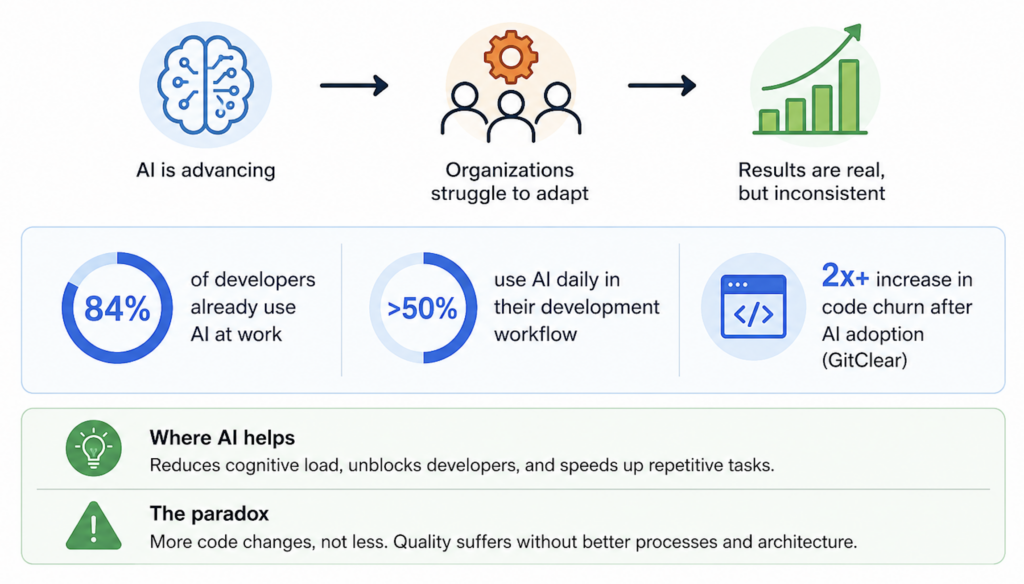
We are facing a paradox. AI is accelerating individual developers like never before, but organizational bottlenecks remain exactly where they were. Deliveries have not improved. In some contexts, they have gotten worse.
Where AI genuinely helps
For isolated tasks, AI performs very well. It removes cognitive load in the first instance, unblocks developers from small obstacles, and allows work to flow with greater speed.
Repetitive tasks are where the gains are most visible. Studies show a reduction of up to 50% in project documentation time. Junior devs, once dependent on real-time mentoring from senior developers, are now opening more Pull Requests than ever, according to GitHub data. AI is concretely supporting that autonomy.
Beyond code generation, areas like QA and DevOps have also reduced time spent with AI tooling. The impact is real and measurable.
But the numbers that actually matter point the other way
Code churn, perhaps the most revealing metric of this moment, more than doubled after AI adoption by teams, according to a GitClear study. And the reason makes sense when you look closely at what AI actually produces.
AI generates isolated code. It does a lot of copy and paste, ignores principles like DRY (Don’t Repeat Yourself), and frequently bypasses architecture patterns in complex, already-existing systems.”
Excessive code duplication generates long-term technical debt — and debt that is very hard to pay off. Refactoring machine-generated code that no one on the team understands how it was built is a serious problem, and it compounds with every sprint.
The latest DORA Report confirmed this: code stability dropped and the fail rate increased over the past year, a trend directly linked to the use of AI tools in software development.
The bottleneck has moved
Productivity is not gained by increasing typing speed. It never was, and with AI it will be no different.
The bottleneck today is no longer code generation. It is integration and testing. And while teams keep looking at output metrics — like lines of code generated — the outcome numbers, the value actually delivered to the business, remain hard to tangibilize.
Developers have always focused more on output than on outcome. But now, with AI, those generation numbers have reached unprecedented levels, making the contrast even more glaring. Lots of code. Little perceived value.
The real challenge of AI today
AI types fast. Very fast. But it does not apply complex architecture patterns to already-existing systems. That is the great advent and the paradox of AI today: the tool that promised to solve development productivity is accelerating the part that was never the real bottleneck.
The path forward is to reorient usage. Measure what matters. And understand that speed of code generation and speed of value delivery are completely different things.
Market pressure alone won’t get you there
Adopting AI because the market demands it doesn’t work. Disruptive technology only delivers when you redesign the way work is done — not just add a new tool to an old process. That is the real shift organizations still need to make.
Sources
Productivity Analysis (+55%): GitHub Blog — Quantifying GitHub Copilot’s impact on developer productivity
Code Churn and Quality Evidence: GitClear Whitepaper
Performance and Engineering Metrics: McKinsey Digital — The Power of GenAI in Software Engineering
Bottlenecks and Flow Culture: Google Cloud — DORA Reports (DevOps Research & Assessment)